English Education

About English Education

Turn your passion for literature, writing, and language into a meaningful teaching career with Viterbo University's English education program. 

You'll combine the depth of an English major with the knowledge and skills needed to become an effective middle or high school English teacher. Through the study of literature, writing, and critical analysis, you'll grow as a communicator, thinker, and educator while preparing to inspire the next generation of readers and writers.

Program Highlights:

  • Guaranteed field placements in outstanding local partner schools
  • Small classes and personalized attention for each student
  • Gain hands-on experience in a local area classroom in your freshman year
  • Learn from experienced teachers and faculty

100% Job placement rate

Guaranteed field placements in outstanding local partner schools

Small classes and personalized attention for each student

Why study this program at Viterbo?

School of Education Faculty and Staff

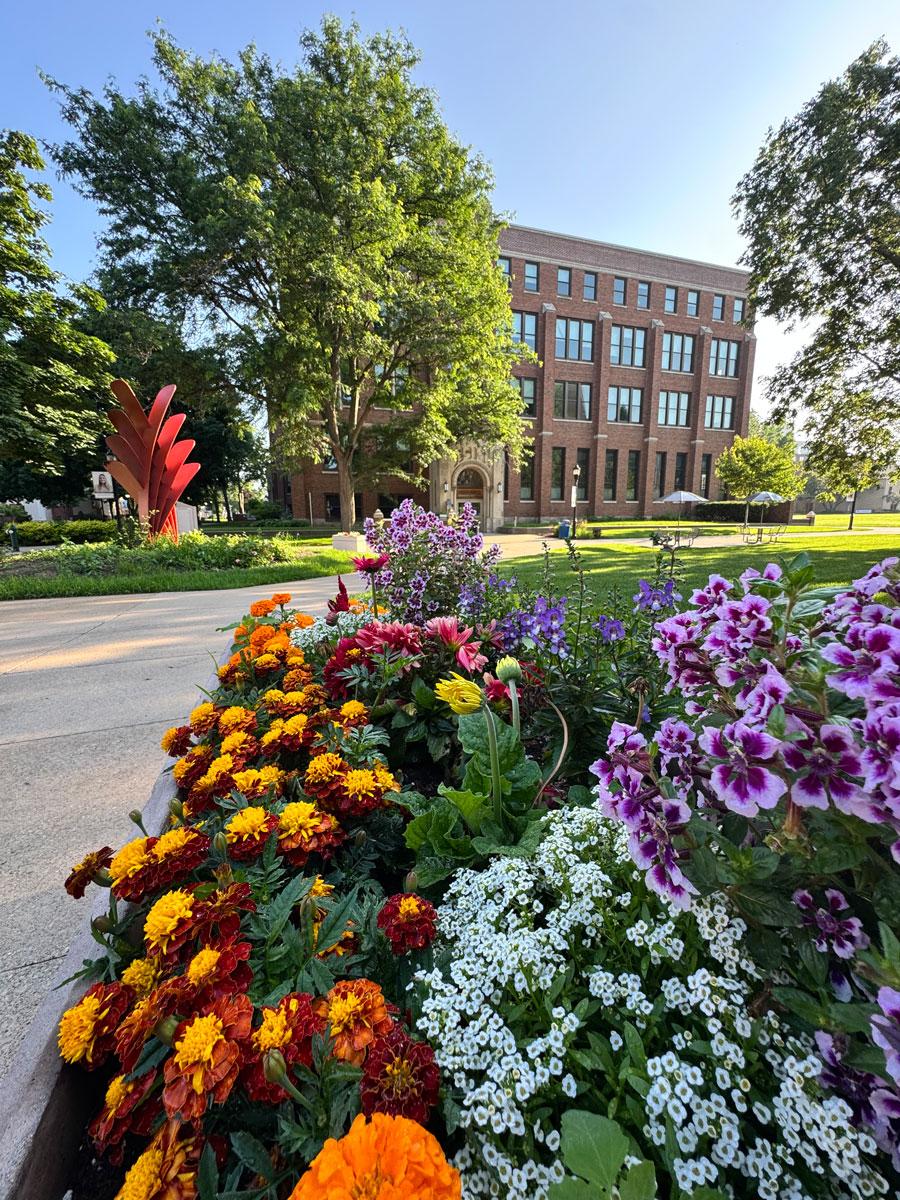
Campus shot with flowers

Ready to get started?

Request Further Information

Art Education

About Art Education

Develop as both an artist and an educator in Viterbo University's art education program. Built on the artist-teacher philosophy, the program recognizes that strong artists become strong teachers. You'll build a solid foundation in drawing, design, and art history while exploring your own creative interests through rigorous studio coursework. At the same time, you'll gain meaningful teaching experience through small, art-specific education classes and hands-on opportunities in schools and the community. From leading the Viterbo Afterschool Art Workshop to serving as a visiting artist in local schools and community art centers, you'll graduate with the confidence, experience, and professional connections to inspire the next generation of artists.

Program Highlights:

  • Guaranteed field placements in outstanding local partner schools
  • Small classes and personalized attention for each student
  • Gain hands-on experience in a local area classroom in your freshman year
  • Learn from experienced teachers and faculty

Careers in art education

Viterbo graduates go on to become

  • K–12 Art Teacher
  • Art Department Chair
  • Museum/gallery educator
  • Art studio manager
  • Teaching artist
  • Graphic designer
  • Production designer

School Partnerships

Guaranteed field placements with outstanding local partner schools

98%

Job placement or graduate school within six months of graduation

Personalized Attention

Small classes and individualized attention for every student

Why study this program at Viterbo?

School of Education Faculty and Staff

Campus shot with flowers

Ready to get started?

Request Further Information

Business Education

About Business Education

Turn your passion for business into a rewarding teaching career. Viterbo University's business education major blends business coursework from the Dahl School of Business with professional teacher preparation through the School of Education, all grounded in a strong liberal arts foundation. You'll graduate ready to teach business at the middle and secondary levels in public or private schools and meet the growing demand for skilled business educators.

Program Highlights:

  • 100% Job placement rate
  • Guaranteed field placements in outstanding local partner schools
  • Small classes and personalized attention for each student
  • Gain hands-on experience in a local area classroom in your freshman year
  • Learn from experienced teachers and faculty

100% Job placement rate

Guaranteed field placements in outstanding local partner schools

Small classes and personalized attention for each student

Why study Business Education at Viterbo?

School of Education Faculty and Staff

Campus shot with flowers

Ready to get started?

Request Further Information

Elementary Education

About Elementary Education

Gain comprehensive training in teaching theory, practice, and your chosen content areas, equipping you with the tools for success in the classroom.

From your first year, you’ll gain hands-on classroom experience in real school settings, supported by dedicated faculty mentors who are invested in your success. Through immersive fieldwork, practical coursework, and personalized guidance, you’ll build confidence, sharpen your teaching skills, and graduate ready to lead your own classroom. 

Program Highlights:

  • 100% Job placement rate
  • Guaranteed field placements in outstanding local partner schools
  • Small classes and personalized attention for each student
  • Gain hands-on experience in a local area classroom in your freshman year
  • Learn from experienced teachers and faculty

Careers in elementary education

Viterbo graduates go on to become

  • Elementary Teacher
  • Special Education Teacher
  • Reading Specialist
  • Curriculum Specialist
  • Early Childhood Teacher
  • Instructional Coordinator

100%

Job placement rate

Guaranteed

field placements in outstanding local partner schools

13

Average class size for personalized attention

Why study this program at Viterbo?

School of Education Faculty and Staff

Campus shot with flowers

Ready to get started?

Request Further Information

Elementary Education (BS Degree Completion)

Finish Your Degree at Viterbo

Unlock your teaching potential with Viterbo’s online elementary education degree completion program.

This pathway leads to a bachelor’s degree and Wisconsin K–9 licensure, with the option to add a cross-categorical or early childhood license. Engage in hands-on classroom experiences where you apply your coursework directly in real K–9 settings. 

Program Highlights:

  • 100% online
  • Complete field service anywhere in Wisconsin
  • Personalized, flexible support
  • Faculty with extensive real-world classroom experience

Strong job demand

$60,000+ median salary

Earn initial K–9 elementary/middle licensure

Why study this program at Viterbo?

Campus shot with flowers

Ready to get started?

Request Further Information

Master of Arts in Teaching

Overview

The Master of Arts in Teaching program is designed for students to explore the core principles of their chosen track, gaining a comprehensive understanding of pedagogy, curriculum development, and instructional strategies specific to their focus area. Whether aiming to teach young learners in elementary schools, specialize in a content area at the secondary level, or work with students with diverse learning needs, this program equips educators with the tools and knowledge necessary to excel in their chosen field.

Policy

Elementary Education | Secondary Content Area Education:

  • Completion of required content coursework with a grade of “C” or better in each course
  • A passing score on the Praxis II in the content area or the ACTFL Oral and Written for Spanish (for students pursuing a Secondary Content Area licensure only)
  • Methods coursework in the content area
  • Pre-Student Teaching field-experience in addition to a full-semester of Student Teaching
  • Earn a passing score on the Wisconsin Foundations of Reading Test (for students pursuing elementary education only)

Cross-categorical Special Education:

  • Completion of required content coursework with a grade of “C” or better in each course
  • Methods coursework in the content area
  • Pre-Student Teaching field-experience in addition to a full-semester of Student Teaching
  • Earn a B or better in EDUC-681

Admission

Admission Requirements for all Graduate Programs in Education (degree, license, endorsement, or certificate) include the following, but may include additional program-specific admission requirements:

  • A minimum cumulative undergraduate GPA of 2.75
  • Completion of required content coursework from undergraduate degree in field of study with a grade of “C” or better
  • All requirements for any graduate program in education must be completed within seven years from the date of application to the graduate program.
  • Coursework must have been taken within the last seven years from the date of application to be applied to program requirements, with the exception of Iowa Educational Leadership programs which is limited to five years.
  • A student must have a cumulative grade point average of 3.0 to complete any graduate program in education and a grade of C or higher earned in all Viterbo University coursework.
  • Students who have completed any Viterbo University graduate program within the last seven years may use up to 15 credits of eligible graduate-level courses to satisfy the elective requirements for degree candidacy in the Master of Arts in Education Program.

Transfer Credit

Upon acceptance, a student may transfer up to six credit hours of graduate credit taken within seven years of the application date.

Learning Outcomes

Developed by the Interstate Teacher Assessment and Support Consortium (InTASC) and adopted by Wisconsin Department of Public Instruction (DPI)

• PUPIL DEVELOPMENT – The teacher understands how learners grow and develop, recognizing that patterns of learning and development vary individually within and across the cognitive, linguistic, social, emotional, and physical areas, and the teacher designs and implements developmentally appropriate and challenging learning experiences.

• LEARNING DIFFERENCES – The teacher uses understanding of individual differences and diverse cultures and communities to ensure inclusive learning environments that enable each learner to meet high standards.

 • LEARNING ENVIRONMENTS – The teacher works with others to create environments that support individual and collaborative learning and that encourage positive social interaction, active engagement in learning, and self-motivation.

• CONTENT KNOWLEDGE – The teacher understands the central concepts, tools of inquiry, and structures of the discipline(s) he or she teaches and creates learning experiences that make these aspects of the discipline accessible and meaningful for learners to assure mastery of the content.

• APPLICATION OF CONTENT – The teacher understands how to connect concepts and use differing perspectives to engage learners in critical thinking, creativity, and collaborative problem solving related to authentic, local, and global issues.

• ASSESSMENT – The teacher understands and uses multiple methods of assessment to engage learners in their own growth, to monitor learner progress, and to guide the teacher’s and learner’s decision making.

• PLANNING FOR INSTRUCTION – The teacher plans instruction that supports every student in meeting rigorous learning goals by drawing upon knowledge of content areas, curriculum, crossdisciplinary skills, and pedagogy, as well as knowledge of learners and the community context.

• INSTRUCTIONAL STRATEGIES – The teacher understands and uses a variety of instructional strategies to encourage learners to develop deep understanding of content areas and their connections and to build skills to apply knowledge in meaningful ways.

• PROFESSIONAL LEARNING AND ETHICAL PRACTICE – The teacher engages in ongoing professional learning, uses evidence to continually evaluate his/her practice, particularly the effects of his/her choices and actions on others (learners, families, other professionals, and the community), and adapts practice to meet the needs of each learner.

• LEADERSHIP AND COLLABORATION – The teacher seeks appropriate leadership roles and opportunities to take responsibility for student learning, to collaborate with learners, families, colleagues, other school professionals, and community members to ensure learner growth, and to advance the profession.

• VITERBO STANDARD – The teacher demonstrates personal qualities and values which reflect the Franciscan values identified in the Viterbo University teacher education conceptual framework.

Graduate Education Licensures and Certificates

Viterbo's graduate education licensure and certificate programs prepare educators to be leaders in their schools and communities. Graduates recognize their obligation to engage in ethical decision-making. They are advocates for best practices in education, student centered instruction, and equity in education. Our graduates understand the importance of remaining current and relevant in educational practices and trends. Viterbo University will revolutionize your instructional practices and prepare you to be an agent for change.

Questions about admissions?

Reach out to Mary Beth Sinniger with questions mbsinniger@viterbo.edu, 608-796-3095

Degree Level

School Business Administrator (WI 5008)

Overview

A program that develops well-prepared and dedicated educators who are willing to work in tandem with other members of the administrative team to achieve educational excellence through their work. Our program focuses on School Business Administrators as being central to the successful operations of a school district through their development of being proactive decision-makers who bring together knowledge and experience to make the best decisions for district funding.

Policy

Admission

Admission Requirements for all Graduate Programs in Education (degree, license, endorsement, or certificate) include the following, but may include additional program-specific admission requirements:

  • A minimum cumulative undergraduate GPA of 2.75 or at least a 3.0 cumulative GPA for 12 graduate credits from an accredited institution in order to be admitted in good standing
  • Earned teaching or administrative license
  • One academic reference contact required for Wisconsin and Iowa Educational Leadership programs

All requirements for any graduate program in education must be completed within seven years from the date of application to the graduate program. Coursework must have been taken within the last seven years from the date of application to be applied to program requirements, with the exception of Iowa Educational Leadership programs which is limited to five years.

A student must have a cumulative grade point average of 3.0 to complete any graduate program in education and a grade of C or higher earned in all Viterbo University coursework.

Students who have completed any Viterbo University graduate program within the last seven years may use up to 15 credits of eligible graduate level courses to satisfy the elective requirements for degree candidacy in the Master of Arts in Education Program

Students who have completed the Viterbo University Post-baccalaureate program within the last seven years may use up to fifteen credits of eligible graduate level courses toward the elective requirement for degree candidacy in the Master of Arts in Education Program

Transfer Credit

Master of Arts in Education and Educational Leadership

Upon acceptance, student may transfer up to six credit hours of graduate credit taken within seven years of application date to be applied to the MAE degree program.  Up to six credit hours taken within seven years of application may be considered for the Wisconsin Educational Leadership program for equivalent graduate courses. Up to six semester credit hours taken within five years of application may be considered for the Iowa Educational Leadership program for equivalent graduate courses.

Learning Outcomes
  • Mission, Vision, and Core Values. Effective educational leaders develop, advocate, and enact a shared mission, vision, and core values of high-quality education, academic success, and well-being of each pupil. 
  • Ethics and Professional Norms. Effective educational leaders act ethically and according to professional norms to promote each pupil’s academic success and well-being. 
  • Equity and Cultural Responsiveness. Effective educational leaders strive for equity of educational opportunity and culturally responsive practices to promote each pupil’s academic success and well-being.      
  • Curriculum, Instruction, and Assessment. Effective educational leaders develop and support intellectually rigorous and coherent systems of curriculum, instruction, and assessment to promote each pupil’s academic success and well-being.  
  • Care and Support. Effective educational leaders cultivate an inclusive, caring, and supportive school community to promote each pupil’s academic success and well-being. 
  • Professional Capacity of School Personnel. Effective educational leaders develop the professional capacity and practice of school personnel to promote each pupil’s academic success and well-being. 
  • Professional Community. Effective educational leaders foster a professional community of teachers and other professional staff to promote each pupil’s academic success and well-being. 
  • Meaningful Engagement. Effective educational leaders engage families and the community in meaningful, reciprocal, and mutually beneficial ways to promote each pupil’s academic success and well-being. 
  • Operations and Management. Effective educational leaders effectively manage school operations and resources to promote each pupil’s academic success and well-being. 
  • School Improvement. Effective educational leaders act as agents of continuous school improvement to promote each pupil’s academic success and well-being.  
  • Teacher Standards. Effective educational leaders understand and demonstrate competence in the teacher standards under s. PI 34.002. 

Reading Specialist (WI 5017)

Overview

An online program that focuses on the social and political aspects of literacy, language variation, and the cultural and community influences on language acquisition and learning. Strength-based approaches to servant leadership, mentoring, coaching, and staff development emphasize positive change and contribution to the common good. Through a sociocultural lens, reading specialist candidates explore district literacy policy to identify and draw upon the literacies and strengths of the educators, parents, and the communities they serve.

  •  10-credits (3 courses) - fully online

Enrollment in the Reading Specialist  licensure only program requires an educational master's degree and the Reading Teacher 1316 license, otherwise it can be combined with the M.A. in Education as the area of emphasis for a total of 31 credit hours.

Policy

Admission

Admission Requirements for all Graduate Programs in Education (degree, license, endorsement, or certificate) include the following, but may include additional program-specific admission requirements:

  • A minimum cumulative undergraduate GPA of 2.75 or at least a 3.0 cumulative GPA for 12 graduate credits from an accredited institution in order to be admitted in good standing
  • Earned teaching or administrative license
  • One academic reference contact required for Wisconsin and Iowa Educational Leadership programs

All requirements for any graduate program in education must be completed within seven years from the date of application to the graduate program. Coursework must have been taken within the last seven years from the date of application to be applied to program requirements, with the exception of Iowa Educational Leadership programs which is limited to five years.

A student must have a cumulative grade point average of 3.0 to complete any graduate program in education and a grade of C or higher earned in all Viterbo University coursework.

Students who have completed any Viterbo University graduate program within the last seven years may use up to 15 credits of eligible graduate level courses to satisfy the elective requirements for degree candidacy in the Master of Arts in Education Program

Students who have completed the Viterbo University Post-baccalaureate program within the last seven years may use up to fifteen credits of eligible graduate level courses toward the elective requirement for degree candidacy in the Master of Arts in Education Program

Wisconsin Reading Specialist License (WI 5017)

  • Possess a current Wisconsin Reading Teaching 1316 License
  • Demonstrated three years of regular full-time teaching experience
  • Have a master's degree in education OR be enrolled in Viterbo University's MAED program
  • Earn a passing score on the Wisconsin Foundations of Reading Test, as required by the Wisconsin Department of Public Instruction

Transfer Credit

Wisconsin Reading Specialist License (WI 5017)

Graduate credits may not be transferred into this program

Learning Outcomes
  • Mission, Vision, and Core Values. Effective educational leaders develop, advocate, and enact a shared mission, vision, and core values of high-quality education, academic success, and well-being of each pupil. 
  • Ethics and Professional Norms. Effective educational leaders act ethically and according to professional norms to promote each pupil’s academic success and well-being. 
  • Equity and Cultural Responsiveness. Effective educational leaders strive for equity of educational opportunity and culturally responsive practices to promote each pupil’s academic success and well-being.      
  • Curriculum, Instruction, and Assessment. Effective educational leaders develop and support intellectually rigorous and coherent systems of curriculum, instruction, and assessment to promote each pupil’s academic success and well-being.  
  • Care and Support. Effective educational leaders cultivate an inclusive, caring, and supportive school community to promote each pupil’s academic success and well-being. 
  • Professional Capacity of School Personnel. Effective educational leaders develop the professional capacity and practice of school personnel to promote each pupil’s academic success and well-being. 
  • Professional Community. Effective educational leaders foster a professional community of teachers and other professional staff to promote each pupil’s academic success and well-being. 
  • Meaningful Engagement. Effective educational leaders engage families and the community in meaningful, reciprocal, and mutually beneficial ways to promote each pupil’s academic success and well-being. 
  • Operations and Management. Effective educational leaders effectively manage school operations and resources to promote each pupil’s academic success and well-being. 
  • School Improvement. Effective educational leaders act as agents of continuous school improvement to promote each pupil’s academic success and well-being.  
  • Teacher Standards. Effective educational leaders understand and demonstrate competence in the teacher standards under s. PI 34.002. 

Reading Teacher (WI 1316)

Overview

An online program that brings educators from across the state to share and unite through a progressive, modern approach to teaching and learning. Educators will develop a deep understanding of authentic instruction and assessment that focuses on the students’ lived experiences, literacies, and funds of knowledge. Asset-based approaches to understanding the influences of Global Englishes, family and community literacies, and social justice will provide educators with the ability to design instruction and assessment, and create spaces of possibility for students.

  • 15-credits (5 courses) - fully online

The Reading Teacher licensure program can be taken as an area of emphasis as part of the MA in Education for a total of 30-credits (10 courses) - online culminating with a four day on-campus residency and graduation ceremony.

Policy

Admission

Admission Requirements for all Graduate Programs in Education (degree, license, endorsement, or certificate) include the following, but may include additional program-specific admission requirements:

  • A minimum cumulative undergraduate GPA of 2.75 or at least a 3.0 cumulative GPA for 12 graduate credits from an accredited institution in order to be admitted in good standing
  • Earned teaching or administrative license

All requirements for any graduate program in education must be completed within seven years from the date of application to the graduate program. Coursework must have been taken within the last seven years from the date of application to be applied to program requirements, with the exception of Iowa Educational Leadership programs which is limited to five years.

A student must have a cumulative grade point average of 3.0 to complete any graduate program in education and a grade of C or higher earned in all Viterbo University coursework.

Students who have completed any Viterbo University graduate program within the last seven years may use up to 15 credits of eligible graduate level courses to satisfy the elective requirements for degree candidacy in the Master of Arts in Education Program

Students who have completed the Viterbo University Post-baccalaureate program within the last seven years may use up to fifteen credits of eligible graduate level courses toward the elective requirement for degree candidacy in the Master of Arts in Education Program

Wisconsin Reading Teacher License, PK-12 (WI 1316)

  • Possess a current Wisconsin Teaching license
  • Demonstrated two years of regular full-time teaching experience
  • Earn a passing score on the Wisconsin Foundations of Reading Test, as required by the Wisconsin Department of Public Instruction

Transfer Credit

Wisconsin License (Reading 1316/ Cross-categorical Special Education)

Upon acceptance, student may transfer up to six credit hours of graduate credit taken within seven years of application date.

Learning Outcomes
  • Foundations of Reading/Literacy Development: Students will convey knowledge of the theories and research in early literacy to evaluate and integrate best practices.
  • Development of Reading Comprehension: Teachers will identify the multiple strands of skills and strategies that build comprehension in the K-12 learner.
  • Reading Assessment and Instruction: Students will demonstrate knowledge and understanding of a variety of assessments and differentiate appropriately based on instructional needs.
  • Integration of Reading/Literacy Knowledge & Understanding: Students will implement authentic literacy instruction across the curriculum.
  • Standard Alignment: Students will identify curricular standards and determine best practices to implement for literacy instruction of the K-12 learner.
     
Subscribe to School of Education